Troy Chases from Start as Texas State Secures 74–62 Win
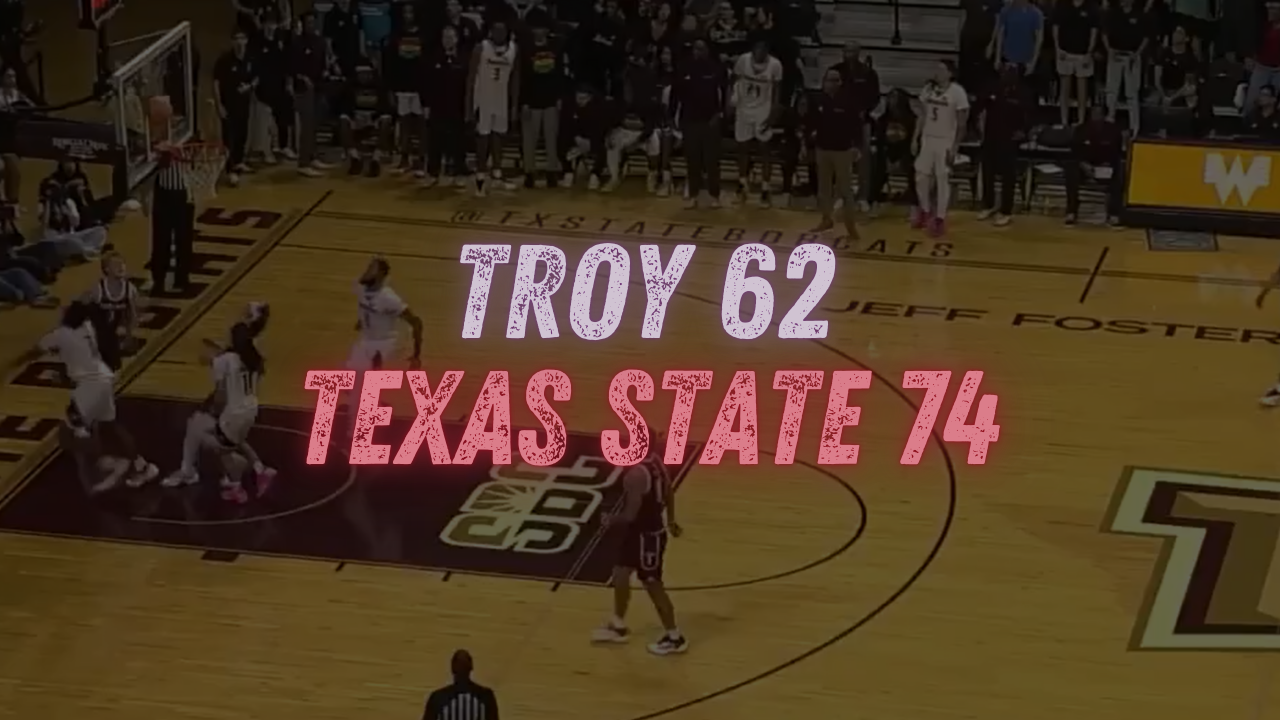
Texas State never trailed and shot nearly 60% from the field to defeat Troy 74–62 on Feb. 11 in San Marcos. Leaning on interior efficiency and steady possession control to hand the Trojans their ninth loss of the season and push them out of first place in the Sun Belt standings.
From the opening tip, Troy was chasing the game.
Texas State set the physical tone early, getting downhill and forcing Troy to defend long possessions that still ended in points. The Bobcats finished 28-of-47 from the field (59.6%) and held a 32–16 edge in points in the paint, a margin that stayed consistent throughout the night. The lead built gradually in the first half and stretched to as many as 17 in the second, leaving Troy searching for stops that never fully arrived.
Head coach Scott Cross said the difference showed immediately.
“They were the more physical, tougher team than us. It started from the jump,” Cross said.
That physical edge translated into efficiency rather than perimeter volume. Texas State made just two three-pointers, but consistently converted midrange and interior attempts. Even shots Troy’s defense was willing to concede found the net, preventing the Trojans from shrinking the deficit.
“They were making 17-foot shots, typically those are shots you want an opponent taking,” Cross said.
DJ Hall led Texas State with 21 points, scoring within the flow and capitalizing on defensive breakdowns. Mark Drone added 15 points and Kaden Gumbs contributed 11, giving the Bobcats balanced scoring that kept the offense steady and difficult to disrupt.
For Troy, Victor Valdes, a Miami, Florida native, carried the offensive responsibility with 22 points. Valdes attacked off the dribble, worked through contact and generated scoring opportunities during stretches where the Trojans struggled to find rhythm. Theo Seng added 14 points and Cooper Campbell chipped in 10, but consistent offensive flow never developed.
Turnovers added to Troy’s challenges. The Trojans committed 15 miscues, limiting transition opportunities and allowing Texas State to maintain control of tempo.
“The bottom line is we turned it over 15 times. If we do that, it’s hard to win any game,” Cross said.
Defensively, Troy struggled to string together stops long enough to create momentum. Texas State’s offense did not rely heavily on three-point shooting, yet its efficiency inside the arc and ability to finish possessions kept the Trojans in response mode for the full 40 minutes. Even short scoring runs by Troy were answered quickly by composed Bobcat possessions.
Cross acknowledged the defensive execution ultimately shaped the outcome.
“If you don’t play better defense than that, you don’t have a chance,” Cross said.
The game never reached a point where Troy felt one run away from control. Texas State dictated spacing, shot quality and interior presence, forcing the Trojans to react rather than allowing them to establish pace.
🤠😼👋#EatEmUp | #NOW pic.twitter.com/GnzSelEQXK
— Texas State MBB (@TXStateMBB) February 12, 2026
With the loss, Troy falls to 17–9 overall and 9–4 in Sun Belt play, relinquishing sole possession of first place in the conference standings. While the defeat does not define the conference race, it highlights how efficiency and defensive consistency become magnified in road matchups.
The final margin reflects a 12-point deficit, but the story centered on sustained execution. Texas State controlled possessions, converted high-percentage looks and maintained physical play from start to finish, while Troy searched for rhythm that never fully arrived.
Conference games often depend on momentum swings, but on Feb. 11 in San Marcos, it came down to execution, and Texas State held that edge from start to finish.
About The Author